How to help Black-owned businesses succeed after Covid-19
Jun. eighteen, 2020


Since the outset of the Covid-19 crisis, my colleagues and I have chronicled the impact of the economic shutdown on small businesses in general and on small businesses owned past people of color in particular.
This enquiry has taken on new significance in recent weeks with the civil unrest following the horrific death of George Floyd and the intensified focus on police brutality and entrenched racial disparities in income, health and wealth.
We now have new data about the state of Black-owned businesses on the eve of Covid-19.
Well-nigh a month ago, the U.S. Census Bureau released its 2022 Almanac Business concern Survey. The survey provides information on selected economic and demographic characteristics for all businesses and business concern owners by sex, ethnicity, race and veteran status. It thus is the most recent national data source that establishes what the small business world looked similar pre-crises.
This article is intended to unveil the meridian-line national findings of our analysis. Information technology makes for sobering reading and, we promise, serves as a call to action at all levels of government and across all sectors of society.
Information technology is the commencement in a series and builds on the research expertise of a shut colleague at Drexel University, Kevin Gillen, also as the remarkable talents of a group of summer interns from MIT, the Harvard Kennedy School, the Academy of Pennsylvania and Yale Law School. It also builds on the practical cognition and inspiring work of a growing group of reflective practitioners at Accelerator for America, Forward Cities, Next Street, The Enterprise Center in Philadelphia and the Minority Concern Accelerator in Cincinnati.
Small business organization is routinely extolled as the lifeblood of the U.S. economy and the path to prosperity for millions of people. The Annual Business organisation Survey reveals that our soaring rhetoric does not match performance reality.
One caveat at the commencement: the Annual Business Survey is an imperfect data source, representing a scaling back of census-provided data from surveys in prior years. Historically, the Survey of Business Owners (SBO) was conducted every five years, and covered the universe of both employer and non-employer businesses; more than than 2 million business owners were surveyed in 2007, as compared to 850,000 in 2022 from the Almanac Concern Survey.
This reduction likely stems from meaning reductions in federal spending on the collection of economics statistics. While the U.Southward. Census Bureau spent $127 1000000 on the Economic Census in Fiscal Year (FY) 2008, that number had shrunk to $105 1000000 in 2018, a reduction of 30 per centum in existent dollars. Every bit the Annual Concern Survey merely covers employer businesses, it excludes 80 percent of all firms in the Usa, and approximately 96 percent of Black-owned firms.
With such a modest sample size, the granularity of data has been reduced at small geographies. We're thus forced to evaluate the current state of businesses with subpar information, due to substantial lack of investment from the federal government in information-gathering on characteristics and trends for business organisation owners.
Initial Findings of the Annual Business concern Survey
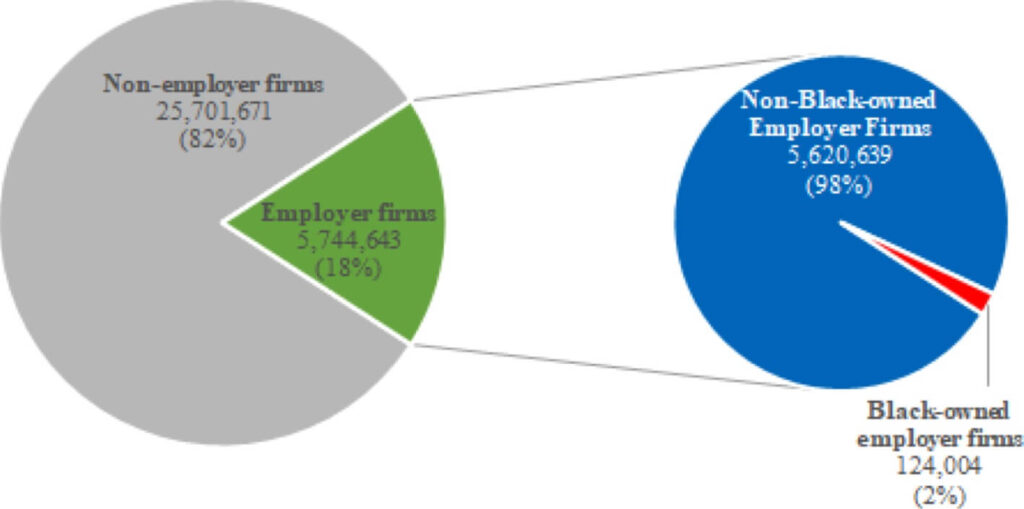
In 2017, the most contempo year for which information is available, there were 31.4 1000000 businesses in the Usa. Of those, approximately 5.7 1000000 firms had employees, representing 18 percent of all firms in the U.Southward..
Out of the 5.7 one thousand thousand employer firms in the U.S., approximately 124,000 are Blackness-endemic employer businesses, representing 2.2 percent of all employer businesses.
For context, according to the 2022 Survey of Business Owners, Black-owned businesses with employees represented ~4 pct of the total number of Black-owned businesses. As the U.Southward. has a Blackness population of nigh fourteen percentage, it shows that Black Americans are vastly underrepresented among business owners.
Since the Census Bureau began tracking the demographics of business organisation owners in 1972, the number of Black-owned employer businesses has grown by 288 percent, barely outpacing overall business creation, which has grown by 260 pct.
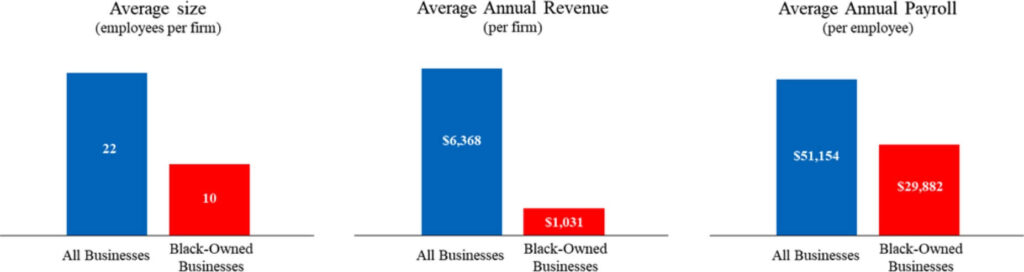
Blackness-owned employer businesses are smaller, with fewer employees, lower average revenues, and lower average payroll expenditures, than businesses overall.
Specifically, Black-owned businesses accept average annual revenues of $ane million, 84 percent smaller than boilerplate revenues for all firms. They have an average of 10 employees, compared to 22 employees for all firms. Their annual payroll per employee is almost $30,000, every bit compared to $51,000 for firms overall. These differences may be explained past manufacture and geography, just information technology points to a dire need for Blackness-owned businesses to scale both their number of employees and revenues in society to reach equity with overall U.S. firm performance.
All the same, Black-owned employer businesses have been growing at a fast prune in recent years. Compared to 2012, Blackness-owned businesses saw total annual revenues abound past 23 percent, twice as fast as U.S. employer businesses overall.
Black-owned businesses have also been adding employees, with the number of employees at Black-endemic businesses growing at 24 per centum, compared to 10.8 per centum for all U.Due south. businesses.
Finally, the total almanac payroll at Black-owned businesses increased by 30.4 per centum compared to 24.8 percent at all U.S. businesses.
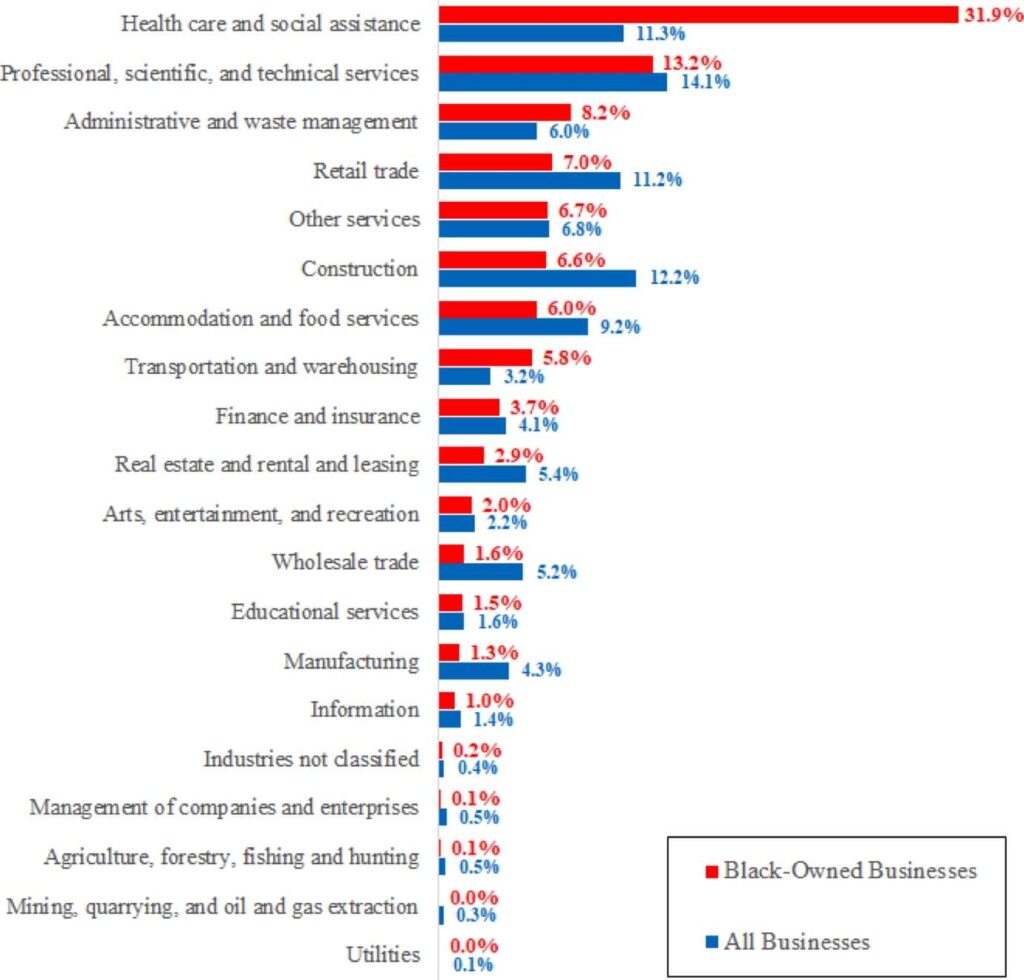
At the national level, information can be disaggregated by race and industry birthday. A main finding that emerges from this assay is that Black-owned businesses are highly concentrated in a few economical sectors.
Of the 19 industries analyzed, 2 thirds of Black-owned businesses can be found in merely five sectors: health intendance and social assistance; professional person, scientific and technical services; administrative, support, waste management and remediation; retail trade; and other services.
These five sectors are composed of smaller sized firms, and underperform in economic terms when compared to others: average sales and payrolls are lower than average levels (with the exception of retail trade and professional services respectively).
Employment at Blackness-owned businesses exhibits an even college degree of industry concentration, as only three sectors take 67 percent of the jobs generated past Blackness-owned businesses: health care and social assistance; administrative, support, waste management and remediation; and accommodation and food services.
Past research from the Association for Enterprise Opportunity has shown that, within the sectoral clusters for Black-owned businesses, they are also concentrated within lower-revenue subsectors. For example, within health care and social assistance, Blackness-owned businesses are overrepresented in childcare and home wellness, and underrepresented in medical, dental, and mental wellness provider facilities. Blackness-owned businesses are too relatively underrepresented in industries such as retail, manufacturing, and construction, which are generally higher revenue industries.
What this Means
The Covid-19 crisis and subsequent social unrest is wreaking havoc on Main Street small businesses beyond the The states. Millions of small businesses take shuttered for the duration of the crisis.
The hardest hit are Principal Street enterprises living on the brink—restaurants, confined, coffee shops, barbershops, hair salons, machine repair shops, dry cleaners and others that provide confront-to-face services. (These are all categorized every bit "other services" inside NAICS.)
With data showing the strong concentration of Blackness-owned businesses in these sectors, people of colour are among the nigh impacted by the current pandemic.
We're already seeing the furnishings. As was shown recently in a working newspaper from the National Bureau of Economical Enquiry, Blackness and Latinx business owners have been disproportionately impacted by the Covid-19 pandemic.
While the underlying survey, the Current Population Survey, includes both business owners for both employer and non-employer businesses, the numbers are stark. Comparing Feb and Apr 2020, the writer found a 41-percent decrease in active Black business owners, and a 32-per centum decrease in active Latinx business owners, as compared to a 22-per centum decrease of active business owners overall.
During the early days of the crisis, many cities enacted local emergency relief funds to give minor businesses the capital infusions they needed to survive until larger pools of capital were fabricated bachelor through the federal regime.
The CARES Act (and subsequent legislation) has deployed several relief vehicles overseen by the Small-scale Business Administration, almost prominently a new Paycheck Protection Program, as well every bit the traditional Economical Injury Disaster Loan program.
Despite the extraordinary efforts, information technology is clear that the federal lending products offered and delivery system used were non aligned with the many small businesses that operate on the periphery of our economic system, particularly underserved small-scale businesses that are endemic by persons of color and/or located in low- and moderate-income neighborhoods.
The nation's starting point on Black-owned businesses is particularly challenging. Data on Black-endemic businesses helps explain three primary limitations of federal relief efforts to appointment:
- Black-endemic businesses are commonly sole proprietorships or businesses with employees that tend to exist small in size and primarily situated within not-advanced sectors of the economy with lower pay and benefits. Black-owned businesses do non have close ties to the mainstream banking organization, are unlikely to tap the SBA relief programs, and are in dire need of objective technical guidance and back up. Black-endemic businesses' economic performance combined with decades of redlining and structural racism in the financial industry put people of color in a particular vulnerable situation to handle financial imbalances and pressures. Contempo enquiry from the Federal Reserve Bank of New York found that over l percent of Blackness-endemic businesses were financially at-run a risk or distressed prior to the electric current pandemic, with shutdowns and lower consumer demand making them more than likely to close, take out debt, or use the owner's personal wealth to prop-up the business organisation.[xi]
- The construction of PPP has also overwhelmingly disadvantaged Black-owned businesses. Smaller firms, with fewer employees, and less access to the mainstream banking world were less likely to access the program equally it was originally designed. Indeed, according to a survey from Goldman Sachs, fewer Black business organisation owners applied for a PPP loan during the initial funding round, and they were approved at a lower charge per unit than businesses overall. With the SBA having not required demographic information on PPP loans, we may non know the extent to which minority business owners were disadvantaged past the plan.
- The Annual Business Survey also shows that Black-owned businesses are likewise younger than most firms, with virtually 50 percent of Black-endemic businesses being in businesses 5 years or less, compared to 36 percentage of all firms. Younger firms may have more residual debt from the startup phase, less savings to cushion an economic disruption, and a shorter track tape to show to lenders if they seek emergency capital during the crunch. A report by the Eye for Responsible Lending found that 46 pct of white-owned businesses were able to obtain credit from a bank over the last five years, while only 23 percentage of Blackness-owned businesses were able to do so. Thus, the structural legacy of Black-endemic businesses generally being undercapitalized combined with the fact that they skew younger than most firms puts them particularly at risk during the crisis.
Equally I accept written before with multiple colleagues, we need a dissimilar playbook going frontward. At that place are several pieces of good news. The most recent expansion of the Paycheck Protection Program mandated portions of the capital letter pool to be distributed through community banks and Community Development Fiscal Institutions (CDFIs); CDFIs, in particular, are sensitive to and engaged with the Black-owned businesses. In addition, a growing number of states are using CARES funding to create small business relief funds that target diverse business organization owners.
Yet more capital that is fit to purpose needs to flow. The RELIEF for Main Street Act, a bi-partisan bill co-sponsored by Senator Cory Booker and the subject area of multiple newsletters, deserves item attention.
The federal government, of form, only plays a fractional role in nurturing and growing businesses endemic by people of color. As we reveal subsequent findings from the Annual Business Survey, we and our colleagues will discuss multiple components of the ecosystem to create demand (e.g., supplier diversity, anchor procurement), provide support for new and existing businesses, heighten access to new forms of capital and regenerate nodes of commerce and community life.
Small business is routinely extolled as the lifeblood of the U.Due south. economy and the path to prosperity for millions of people. The Annual Business Survey reveals that our soaring rhetoric does not lucifer operation reality. This is just the latest indication of a policy and market failure that is systemic and deeply rooted.
Only a well thought-out structural response and a radical surge in public, private and borough investment in all aspects of the small business ecosystem volition yield different results.
Bruce Katz is the director of Drexel Metro Finance Lab, created to help cities design new institutions and mechanisms that harness public, private and borough upper-case letter for transformative investment. Kevin Gillen is a senior inquiry young man at the Lindy Institute for Urban Innovation at Drexel University. Ben Preis is a doctoral student at MIT's Department of Urban Studies and Planning and is currently a graduate research analyst at the Nowak Metro Finance Lab at Drexel University. Victoria Orozco has recently completed the Master in Public Administration in International Development at the Harvard Kennedy School and is currently a graduate research analyst at the Nowak Metro Finance Lab at Drexel University.
Photo courtesy Stuart Price 
Source: https://thephiladelphiacitizen.org/black-owned-businesses-covid-19/
0 Response to "How to help Black-owned businesses succeed after Covid-19"
Post a Comment